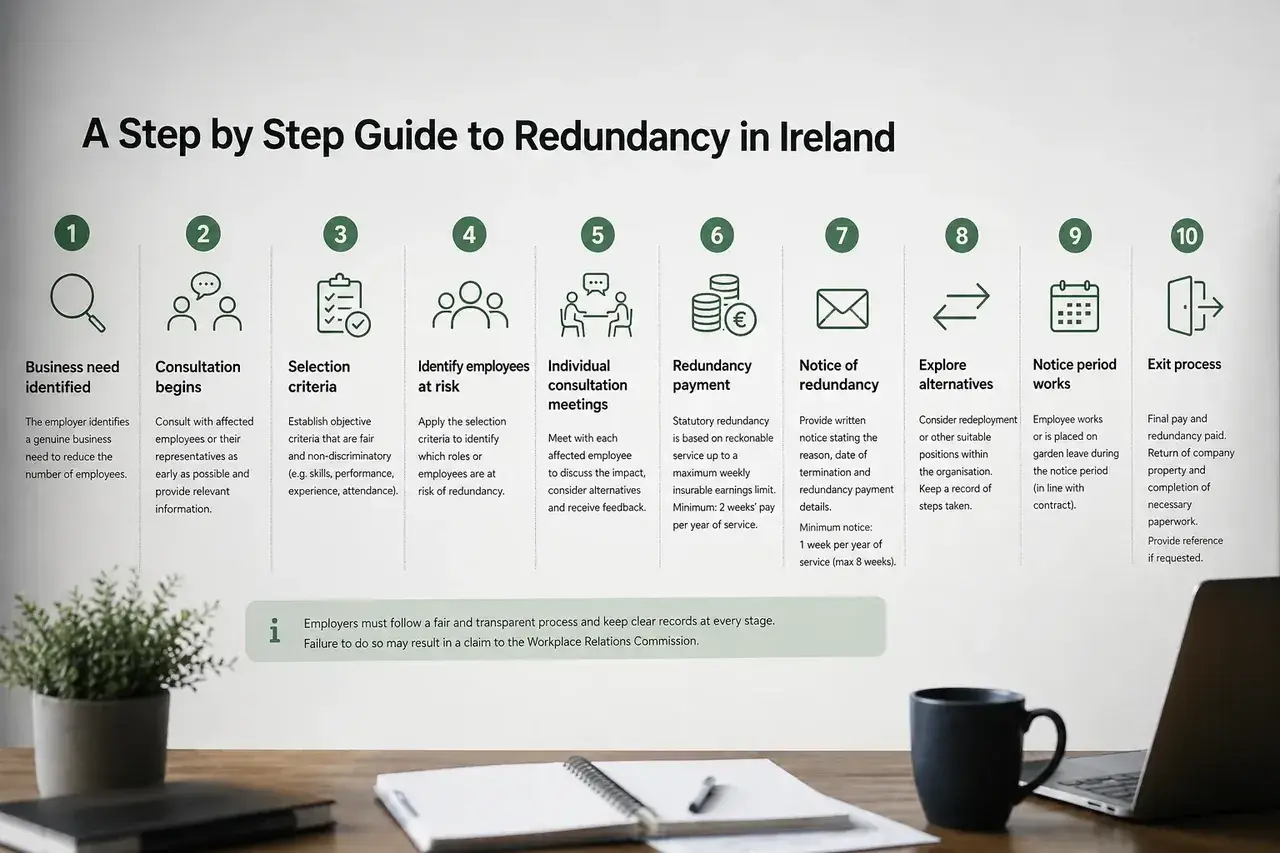


Statutory redundancy in Ireland is a clear entitlement for qualifying employees. They need two years of continuous service, an insurable PRSI class, and a genuine redundancy situation. That much is straightforward on paper. The picture changes when a business uses agency arrangements or contractor labels to engage its workforce, because the question of who owes that redundancy payment gets complicated fast. A recent Irish Times report on a large-scale contractor dispute highlighted exactly this problem. Over 700 workers were facing planned redundancies, and the contracting entity declined to engage with the WRC on the matter.
The Quick Answer on Contractor Redundancy
Labelling a worker as a contractor or routing them through an agency does not automatically remove their entitlement to statutory redundancy in Ireland. If the working relationship has the hallmarks of employment, the WRC will look past the label. The liability then falls on the entity that controlled the work. The financial consequences can be severe.
What the Dispute Tells Irish Employers
The dispute involved a staffing company supplying workers to a major technology operation. When mass redundancies were announced, the contracting entity did not attend a WRC hearing to discuss the planned job losses. The union involved described the situation as making redundancy rules “worthless” if a contractor body can simply decline to participate.
For Irish SMEs, this is not just a story about a multinational. The same dynamics play out in construction, manufacturing, and hospitality every day. A business engages workers through an intermediary. Those workers turn up at the same site, follow the same instructions, use the same equipment, and work the same hours as direct employees. Then, when the work dries up, the question lands: who owes these people their statutory redundancy payment?
The Redundancy Payments Acts 1967-2014 and the Protection of Employees (Temporary Agency Work) Act 2012 both have something to say about this. The answer depends on who the actual employer is. That determination looks at substance over form.
Why the Label on the Contract Is Not Enough
The WRC has consistently held that the nature of the working relationship matters more than the title on the agreement. A worker can be called an independent contractor in every document they sign. If the day-to-day reality says otherwise, they can still be found to be an employee.
The tests the WRC and Revenue apply look at control, integration, economic reality, and mutuality of obligation. In practice, that means examining whether a business controls when, where, and how the work is done. It also means asking who provides the tools and equipment, and whether the worker depends on that single engagement for their income. When those answers all point to the business, the relationship looks like employment regardless of the paperwork.
This matters enormously for statutory redundancy in Ireland because the payment obligation sits with the employer. If the WRC determines that your “contractor” was actually an employee, the redundancy liability is yours. Two weeks’ pay per year of service, plus a bonus week, subject to the €600 weekly ceiling. For a worker with ten years of service, that figure adds up quickly.
In our experience advising employers across Ireland, this is one of the most underestimated financial risks in workforce planning. Businesses assume the agency or contractor arrangement creates a clean separation. It rarely does. Mapping where the employment relationship actually sits turns that assumption into a documented position you can defend. That mapping is what redundancy and workforce classification support for employers is built around.
The Agency Worker Angle
Agency workers present an additional layer of complexity. Under the Protection of Employees (Temporary Agency Work) Act 2012, they are entitled to equal treatment on basic working and employment conditions. That entitlement applies from day one of their assignment. Whether the agency or the hirer is the employer for redundancy purposes depends on the specific arrangement. It also depends on how the WRC interprets that arrangement.
When we guide clients through workforce restructuring, one of the first steps is mapping every worker engagement. That mapping shows where the employment relationship actually sits. This is not a five-minute exercise. It requires reviewing contracts, examining day-to-day working arrangements, and assessing which entity exercises genuine control. A situation we see frequently is an employer who has engaged workers through an agency for years and treated them identically to direct staff. The exposure only becomes apparent when redundancies loom.
Getting this wrong does not just mean an unexpected redundancy bill. It can trigger claims under multiple pieces of legislation simultaneously. Those range from unfair dismissal to unpaid annual leave entitlements for periods the worker was misclassified.
Contractor Redundancy Rights: The Obligations You Cannot Outsource
Some obligations follow the reality of the employment relationship, not the contractual structure. Statutory redundancy is one of them. You might have a written agreement with an agency stating that redundancy is the agency’s responsibility. The WRC may still look through that arrangement if it finds the hirer was the true employer.
Employers who rely on these arrangements need to understand three things:
- The contractual allocation of liability between your business and the agency is a commercial agreement between two parties. It does not bind the WRC or the worker.
- If the agency becomes insolvent or refuses to engage (as happened in the dispute reported in May 2026), the worker will come after the entity that directed the work. That is your business.
- The collective redundancy consultation requirements under the Protection of Employment Act 1977 are triggered by a sliding scale that depends on the size of your workforce, measured over any period of 30 consecutive days. The threshold is at least 5 redundancies in a business with 21 to 49 employees, at least 10 in a business with 50 to 99, at least 10 per cent in a business with 100 to 299, and at least 30 in a business with 300 or more. Failing to consult properly adds a separate layer of liability on top of the individual redundancy payments.
Collective redundancy consultations across a mixed workforce of direct employees, agency workers, and contractors take real coordination. This is exactly the kind of operational challenge that catches employers off guard. Timelines are tight and documentation requirements are specific. The WRC also expects evidence that meaningful consultation took place.
The Hidden Cost of Getting Classification Wrong
Beyond the immediate redundancy payment, misclassification exposes an employer to backdated liabilities. Revenue can pursue unpaid PRSI contributions for the entire period of misclassification. The worker can claim unpaid annual leave, public holiday pay, and other statutory entitlements denied to them during their engagement.
A WRC adjudication that reclassifies a contractor as an employee does not just apply going forward. It establishes what the relationship always was. The financial impact compounds with every year the arrangement was in place. Contractor and agency arrangements are widespread in construction, manufacturing, and hospitality. For businesses in those sectors, this is a risk that deserves serious attention.
What Employers Should Be Thinking About Right Now
The May 2026 dispute is a large-scale, high-profile example. But the same principles apply to a small manufacturer in Longford engaging three “contractors” on the factory floor. They apply just as much to a Dublin restaurant routing kitchen staff through an agency. Scale changes the numbers, not the legal exposure.
If your business engages workers through any arrangement other than direct employment, you need clarity on where the employment relationship sits. That clarity has to come before you face a restructuring or downturn. Discovering the answer during a redundancy process is the worst possible timing.
An audit of your current workforce arrangements can identify misclassification risks before they become WRC claims. In practice, that means reviewing each engagement against the established tests for employment status. It also means checking that agency agreements properly address liability allocation, and making sure you hold the documentation to support the classification you rely on. Our employment advice team handles these audits for employers regularly. They almost always surface at least one arrangement that needs restructuring.
How PurpleTree Helps with Contractor Classification
Contractor status, agency arrangements, and redundancy obligations intersect in ways that are hard to unpick. This is precisely the kind of multi-layered HR challenge that PurpleTree manages for Irish employers. Our team provides strategic HR consulting that includes workforce classification reviews, redundancy planning, and WRC representation when disputes arise.
We work with employers to structure their workforce arrangements properly from the outset. When business needs change, the redundancy process then runs without nasty surprises. Where restructuring is already underway, our HR Essentials service covers every step of the consultation and payment process, so each one is handled correctly and documented thoroughly.
Getting this wrong carries a cost in WRC awards, backdated liabilities, and operational disruption. That cost far exceeds the cost of getting it right from the start.
If you are concerned about contractor or agency worker classifications in your business, or you are planning a restructuring and want to understand your redundancy exposure, contact PurpleTree HR to arrange a workforce classification review.
This article is for general informational purposes only and does not constitute legal advice. Employment law is complex and fact-specific. For advice on your specific situation, contact the PurpleTree HR team directly.
Contractor redundancy questions answered
On this page